


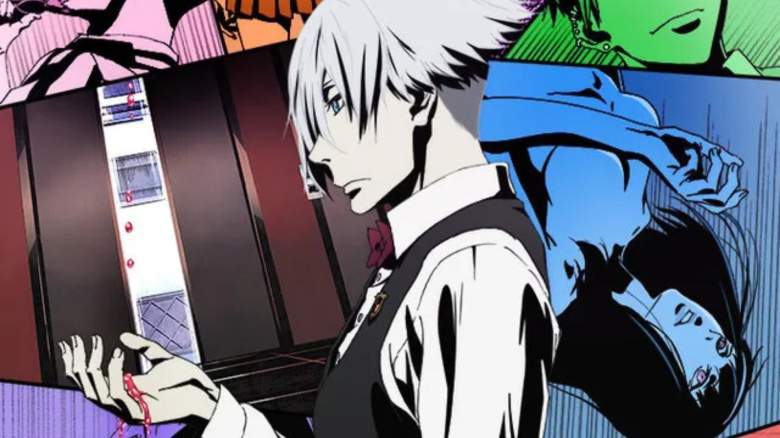
The bar was terrifying before anyone understood how it worked.
Death Parade, the 2015 Madhouse psychological anime created by Yuzuru Tachikawa, has been circulating through rewatch culture with renewed energy lately. Fans coming back to it are putting something into words that was always felt but rarely articulated. It falls into a category that dark, atmospheric anime has been consistently exploring in 2026 — the idea that what a story withholds can be more powerful than what it reveals. Death Parade‘s early episodes understand this completely. It is what separates them from everything that comes after. The central mechanism at work here is what this article names the Quindecim Paradox: a setting’s power is inversely proportional to how fully the viewer understands its rules.
The less Quindecim is explained, the more frightening it becomes. The moment Death Parade begins to answer its own questions — to offer the viewer a map of the system — that anxiety softens into something more like dramatic observation. What the series achieved in Episode 1 is precisely what it quietly let go of before the final stretch. The Death Parade mystery is not just a tone question. It is the structural engine the show runs on, and halfway through, that engine changes.
The Death Parade Mystery Worked Because the Audience Was as Lost as the Dead
The early episodes lock the viewer and the newly arrived characters into identical uncertainty. Nobody understands the rules. Nobody knows whether winning or losing the game matters. Nobody can read Decim. That shared disorientation is the source of everything the first half achieves.
The games become disturbing because they should not be disturbing. Darts, billiards, and air hockey have no business feeling threatening. Death Parade makes them feel that way by refusing to resolve the source of the wrongness. Viewers do not watch from a safe distance. They are dropped into the same moral fog as the characters, unable to determine whether what they are observing is fair, cruel, or simply beyond any human framework of fairness.
Decim himself is the anchor for this effect. Polite, unnervingly calm, and coded as neither villain nor protector, the early Decim carries an enormous presence built entirely on ambiguity. His neutrality does not read as safety. It reads as something operating on a different logic than the people around him — and that unreadability is a dramatic tool of considerable power.
The Quindecim Paradox: Why Answering the Questions Cost the Show Its Dread
As Death Parade develops, it starts explaining itself. Viewers learn how arbiters are structured, how the judgment process is designed, what distinguishes reincarnation from the void. Each of these reveals has genuine dramatic weight. Serialized storytelling that builds toward emotional clarity is not a weakness in itself. Here, though, the accumulation of answers changes the nature of the experience in ways the series may not have fully anticipated.
Decim’s movement toward emotional legibility is the most significant of these shifts. As Chiyuki’s presence changes him, the series gains a more conventional emotional arc and a more recognizable character study. What it loses is Decim as an element of the world’s mystery. Early Decim felt inseparable from the strangeness of Quindecim itself. Later Decim is a character the viewer is guided to understand and care about. Both versions are valid. They are not the same.
The Quindecim Paradox applies most clearly to the moral stakes. Early Death Parade makes no promises about whether the system is just, broken, or simply indifferent. The judgments feel slippery — people reveal terrible things about themselves under extreme, manufactured pressure, and the series refuses to tell the viewer whether that counts as truth. That is the show’s sharpest quality. Once it begins clarifying its own ethical framework, that moral uncertainty becomes easier to organize — and easier to observe without being disturbed by it.
Death Parade: 5 Things You Should Know
1. The cheerful opening was a deliberate lie. “Flyers” by BRADIO — an upbeat swing number over characters dancing joyfully — was confirmed by director Yuzuru Tachikawa as intentional tonal misdirection, designed to disorient new viewers immediately.
2. The entire franchise began as a government-funded animator training exercise. Death Billiards, the 2013 short film that preceded Death Parade, was produced under Anime Mirai — a Japanese government initiative funding young animators. The series that followed was an expansion of that project.
3. Decim’s mannequin collection is never explained. His habit of creating mannequins resembling guests who made an impression on him is introduced and never resolved — whether it represents grief, connection, or something else is left entirely to interpretation.
4. Twelve episodes. That is all it took. Death Parade consistently places on major psychological anime lists — often ahead of series with three or four times the runtime. It achieved its critical reputation in a single, compact season with no continuation.
5. It won the 2016 Anime Trending Awards for Best Original Anime — beating much larger franchises. For a non-shonen, non-sequel series from a first-time director to top a major fan-voted category that year remains one of the more underappreciated results in recent anime awards history.
Death Parade is a remarkable series. Its first half remains among the most effectively unsettling anime produced in the past decade. What the second half surrendered was not quality. It was the precise, irreplaceable sensation of not knowing whether any of it was fair — and that is exactly what made the Death Parade mystery so impossible to shake.
Some shows answer their questions and become more satisfying. Death Parade answered its questions and became less frightening. The distinction says everything.
The bar was most terrifying when it had no floor plan.









Comments
The One Thing Death Parade Got Right in Its First Episode That the Rest of the Series Quietly Abandoned