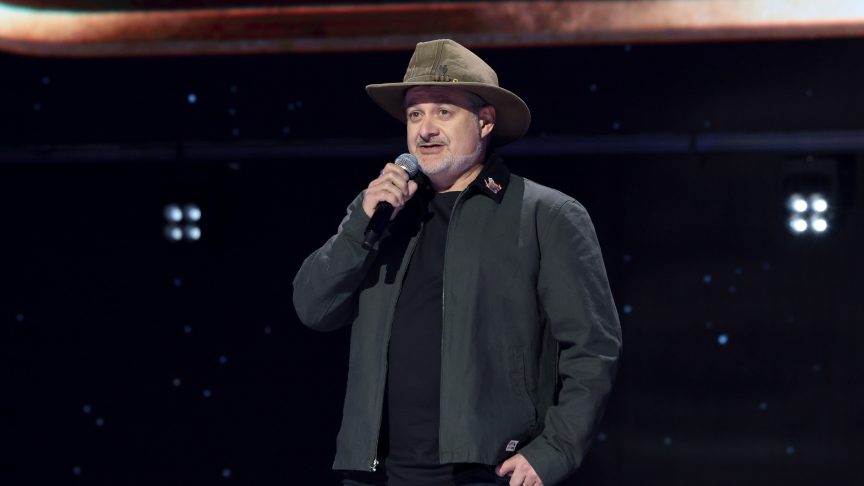
Dito Montiel doesn’t believe in waiting for permission. The filmmaker behind “A Guide to Recognizing Your Saints” with Robert Downey Jr., “Fighting,” and “Riff Raff” has built his career on instinct and a punk rock do-it-yourself spirit. For Montiel, the barriers that once kept artists from creating are gone — and the only mistake is sitting back and waiting for someone else to open the door.
“In the do-it-yourself world, and I know no young filmmaker wants to hear this, but the truth is, is you don’t need anybody, you know?” Montiel said in an exclusive interview with EntertainmentNow. “Like, you really don’t. And it’s kind of like music, you know what I mean? Like, you used to have to have this big record deal and this machine behind you. Now, man, you put out a freaking song, you put it on Spotify or whatever, go book a tour and enjoy the world, you know? Who cares? Do it in a van, that’s life, you know? And with film, you can make it now, you know? And who knows, you know? I mean, if you’re sitting back – and I’m talking to myself as well, this is not just a new filmmaker, anybody. If you’re sitting back and you’re waiting for the studio to call, man, then forget it, you know?”
That spirit — fearless, authentic, and dedicated to make something real — defines Montiel’s career.
Dito Montiel On Why He Refuses To Storyboard
 Getty
GettyMontiel is quick to reject Hollywood’s obsession with rigid preparation. “I’m so in the thick of it,” he said. “I don’t do storyboards because I like finding. I don’t want to over plan it, because I find that kills it. You go out there and find it, and then something happens you could never have written down.”
That sense of discovery carries over to how he works with actors. He doesn’t see them as executing a plan but as collaborators who can completely shift a scene. “It’s similar to actors to me. They surprise me,” Montiel explained. “You think you know what a scene is going to be, then they do something unexpected and you realize, oh, that’s the scene. It’s my job to recognize it when it’s real and get out of the way.”
For Montiel, filmmaking is alive only when it’s unpredictable.
How Rome And Calabria Shaped “Captivated”
 Getty
GettyMontiel’s next film, “Captivated,” starring “Godfather” icon Al Pacino, explores the 1973 kidnapping of John Paul Getty III. But to him, the real star is Italy itself. The movie is continuing production in Rome and Calabria, and Montiel says the places themselves are shaping the story in ways no script could.
“You spend two months somewhere, going to every single location, people’s houses,” Montiel said. “It’s like the crash course in anywhere you go.”
That immersion, he explained, doesn’t just influence logistics — it changes the film at its core. “Rome and Calabria dictated so much,” Montiel said. “You spend time walking down streets, sitting in kitchens, seeing how people move through their homes. Suddenly the place tells you how to shoot it.”
Even after leaving Italy, its impact stuck with him. “Even after I leave, I’ll find myself missing it,” he said. “Oh man, I miss walking down the street in Pignetto. It influences you in every way.”
For Montiel, the landscapes are more than backdrops. “The hills, the streets, the apartments — they all end up telling you who the characters are,” he said. “And once you see that, you realize the film isn’t about what you wrote. It’s about what you found.”
From Punk Rock to Film: Dito Montiel’s DIY Spirit
 Getty
GettyMontiel’s filmmaking roots stretch back to the New York hardcore scene, where he first learned the value of expression over perfection.
“As a kid, I wrote dumb ideas on napkins, like everybody else,” he said. “You get drunk one night when you’re a teenager and you write whatever idiotic idea on a napkin because you think it’s genius and you wake up in the morning and you don’t know what the hell you wrote. But I always wanted to write because for me, it was just something that made me feel good, you know, and I didn’t plan to ever work in anything like this. My father was a typewriter mechanic from Nicaragua. This was not in the cards for me. None of this was. But I just liked it.”
Music gave him the courage to create without worrying about perfection. “Being in a band was just—I didn’t really play the guitar very well. And I certainly didn’t sing well, I just screamed, but I fell into this little hardcore world, punk rock, hardcore world in New York that was very tiny at the time,” Montiel recalled. “Instead of sitting at home and learning how to play Led Zeppelin riffs, we went on stage and played horrible songs that we wrote and screamed. But I really liked it because it was a lot more fun to get on a little stage.”
That same instinct carries into his directing. “With movies, it’s the same thing. If you let me, I’ll keep trying. Like it was not about perfection in music ever for me. I’d rather get up there and do something, try something, and maybe it works and maybe it doesn’t. So when I had the chance to jump into movies, I still try as hard as I can to take that approach that I’m just going to go, I’m just going to do it.”
Montiel says that attitude is what keeps him moving forward. “I have this do-it-yourself attitude mentality that I have since I was a kid,” he said. “And I love when I see it in other people, you know, and it seems like the world is getting a lot more DIY now anyway, which I’m all for, I hope. But music influenced it more in a spiritual way maybe than a perfection way. I was never a very good musician and I’m probably not a very craftsman of a film. I just go out and do stuff. And that’s the goal, just to do stuff, not to perfect it.”
Montiel also points back to his time directing Robin Williams on “Boulevard,” the actor’s final completed film. Williams told him that filmmaking felt like a circus — an intense few months of living in each other’s worlds before everyone drifts apart — a perspective Montiel says still shapes how he sees the craft.
Allen Ginsberg and Making Art For the Right Reasons
 Getty
GettyMontiel says one of the most important lessons he ever absorbed about being an artist came from a chance encounter as a teenager with legendary poet Allen Ginsberg.
“I’ll give you one last thing, because this is from Allen Ginsberg, right?” Montiel recalled. “I met him when I was a teenager because he took pictures of me and my friends, my band, actually, right? And he said he lived in this – you know, the great writer, of course, and he lived in this apartment on 12th Street, you know? And I remember thinking, wow, what a big apartment, you know? And he said, oh, yeah, this is great. You know, it’s a four-bedroom or something. He goes, it’s rent control. He goes, it lets me be a writer.”
At the time, Montiel didn’t fully understand what that meant. But as he got older, it struck him as the purest example of what being an artist is really about. “It didn’t really hit me what he had said as a kid, you know? And all these years later, I think, wow. He looked reverse-engineered writing, you know? The rent control apartment let him be a writer as opposed to people who think, oh, if I become a writer, I’ll get to buy a mansion, you know? And I thought, what a great way to look at things, you know?”
For Montiel, the lesson wasn’t about survival — it was about purpose. “He liked that he had a rent control apartment because it let him be a writer,” Montiel said. “And I thought, that’s excellent. So that’s maybe a good way for filmmakers or musicians or whatever you want to be, painters, to sort of look at life. We need more of it, that’s for sure.”
It’s a philosophy that has guided Montiel’s entire career: make the work because it matters to you, not because it promises status or wealth. In punk clubs, on the streets of Rome, or behind the camera, Dito Montiel is still doing exactly that.