


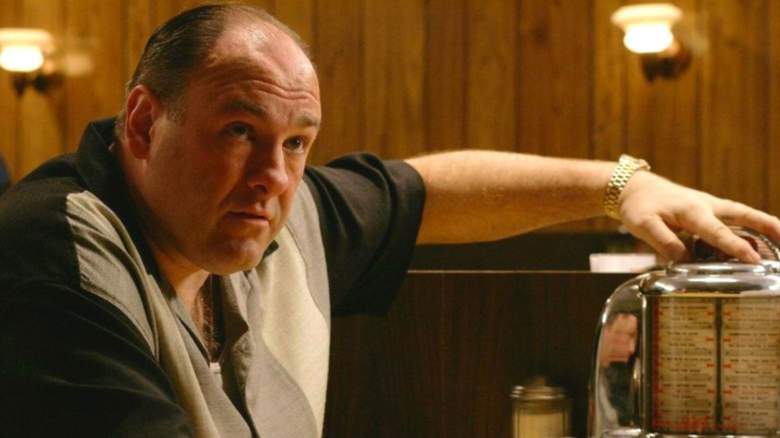
Nearly two decades after “The Sopranos” aired its final episode, the ending remains one of television’s most discussed moments.
The HBO drama followed mob boss Tony Soprano, played by James Gandolfini, as he balanced family life with his role in organized crime. During its six-season run from 1999 to 2007, the series became one of television’s most acclaimed dramas.
The final episode, “Made in America,” ended with Tony sitting down for dinner at Holsten’s Diner with Carmela and A.J. while waiting for Meadow to arrive. As Journey’s “Don’t Stop Believin'” played on the jukebox, the camera lingered on several unfamiliar faces entering the restaurant, including the now-famous man in the Members Only jacket. Just as Meadow appeared to be walking through the door, the screen suddenly cut to black.
The unexpected ending left viewers stunned and immediately sparked debate. Some fans were convinced Tony was killed in the diner, while others believed the scene was meant to show that he would spend the rest of his life looking over his shoulder. Nearly 20 years later, the finale remains one of the most talked-about endings in television history, with fans, cast members, and creator David Chase still discussing what really happened in those final moments.
David Chase Explains the Meaning Behind the Final Scene on ‘The Sopranos’
Over the years, creator Chase has largely avoided providing a definitive answer about Tony’s fate.
“I had no idea [the ending] would [cause] that much of an uproar,” Chase told The Hollywood Reporter in 2021. “What was annoying was how many people wanted to see Tony killed. That bothered me … They wanted to know that Tony was killed.”
Chase reiterated his reluctance to provide straightforward answers during a January 2024 interview with People.
“I really hate spoon-feeding the audience,” he said.
In the 2024 documentary “Wise Guy: David Chase and The Sopranos,” Chase discussed the creative influences behind the finale. He explained that scenes showing Tony visiting family members before arriving at the diner were inspired by Stanley Kubrick’s “2001: A Space Odyssey.”
“This simple technique, it’s always mesmerized me,” Chase said. “In [The Sopranos] episode, [with] everyone he goes to see, he walks into his own POV. It made me think of time, and, I guess, approaching death or approaching something. There’s something mystical about it.”
The sequence includes Tony visiting his sister Janice after Bobby Baccalieri’s death and later seeing Uncle Junior in a nursing home.
David Chase Has Repeatedly Referenced a Potential Death Scene
While Chase has never directly confirmed Tony’s fate, several of his comments have fueled speculation that the character died in the final scene.
During a discussion with “The Sopranos Sessions” co-author Alan Sepinwall in 2019, Chase appeared to accidentally reference the diner sequence as a death scene.
“Yes, I think I had that death scene around two years before the end … But we didn’t do that,” Chase said.
He later clarified that his original vision for the finale involved a different setting.
“The scene I had in my mind was not that scene. Nor did I think of cutting to black,” Chase told The Hollywood Reporter in 2021. “I had a scene in which Tony comes back from a meeting in New York in his car. At the beginning of every show, he came from New York into New Jersey, and the last scene could be him coming from New Jersey back into New York for a meeting at which he was going to be killed.”
In “Wise Guy: David Chase and The Sopranos,” Chase also referenced an earlier scene involving Meadow and A.J. discussing a Robert Frost poem.
“Why cut to black?” Chase asked. “There was that scene between Meadow and A.J. This is a long time back. He was doing his homework. ‘Woods on a Snowy Evening’ I think is the name of the poem … Robert Frost poem. ‘I thought black meant death.’ But, see, now people will say, ‘See, he admitted, Tony died.’”
The documentary then cut to black before Chase could finish his explanation.
‘The Sopranos’ Cast Remain Divided on Tony Soprano’s Fate
Members of the cast have continued discussing the finale years after it aired.
Michael Imperioli, who played Christopher Moltisanti, admitted he was surprised by the ending.
“There’s tension building in that diner scene. We’re expecting something,” Imperioli said in “Wise Guy: David Chase and The Sopranos.” “And then it goes to black. It was so sudden and strange. Really took everybody by surprise.”
Drea de Matteo recalled thinking her television had malfunctioned.
“I started calling everybody and I’m like, ‘Yo, did my TV just go out?’” she said. “And I’m thinking to myself, ‘This is David … This is exactly how he wanted to end the show. He doesn’t want anyone to know what’s going on right now.’”
Edie Falco, who played Carmela Soprano, said she initially believed pages were missing from the script.
“Then I knew in a larger part of myself that it had meaning and significance that eluded me,” Falco told the Television Academy Foundation in 2017. “I never doubted that it did have significance and meant something or was meaningful in some way because I trusted David. I know he put a lot of thought into how to end it.”
Sigler also praised the ambiguity of the ending.
“I think it ended perfectly,” she said on “Watch What Happens Live” in 2019. “I think that whether he died or not, people would’ve been upset or not satisfied. So I think it left it for everyone to have their own perfect ending for Tony Soprano.”
Robert Iler believes the unresolved nature of the finale explains its lasting impact.
“If the last scene was just Tony getting shot in the head, that would have been it,” Iler told RadioTimes.com in 2017. “People would have talked about it for a month or two, and then it would have been over. But to have an open ended discussion still 10 years later, obviously what he did was genius.”
Fans can watch all seasons of “The Sopranos” on HBOMax.
Comments
‘The Sopranos’ Finale Mystery Lives On as New Clues About Tony Soprano Continue to Surface