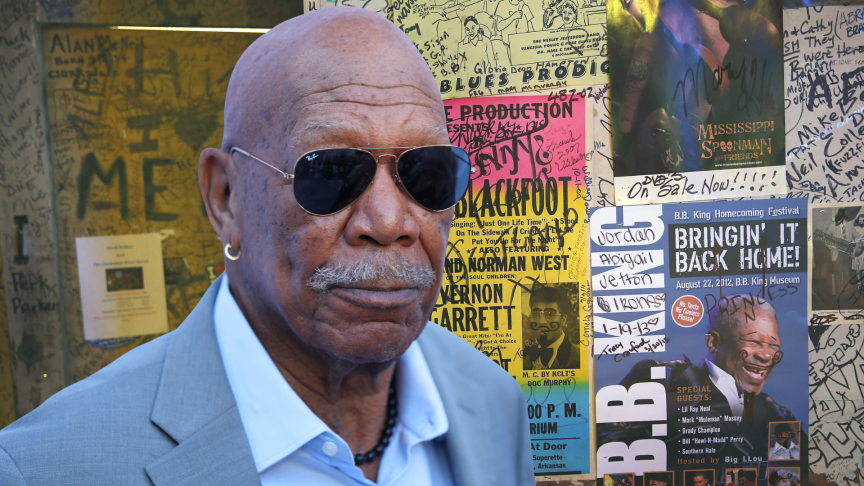
Morgan Freeman has spent more than seven decades building one of the most recognisable careers in entertainment. He is an Oscar winner, a Golden Globe recipient, a narrator whose voice has become almost as famous as his face, and a performer whose work spans film, television, Broadway and beyond.
But now, just one year shy of his 90th birthday, Freeman is turning toward something far more personal.
According to Rolling Stone, he has announced his first-ever album, “Morgan Freeman’s Symphonic Blues Experience.” The release is not positioned as a reinvention, but as a return. A return to the music he first heard as a child in the Mississippi Delta.
The 12-track album traces 100 years of blues music. Freeman serves as narrator and producer. The project brings together artists including Taj Mahal, Keb’ Mo’, Shemekia Copeland and Chineke! Orchestra. It will be released on August 7 via Decca Records.
For Morgan Freeman, this is less a side project than a personal archive of influence and memory, shaped by the sound that Freeman says never left him.
From Mississippi Porch to a Lifelong Sound
According to Parade, Morgan Freeman’s connection to the blues began long before fame, awards or Hollywood recognition. It began in his childhood in the Mississippi Delta.
“I heard the blues for the first time on my grandmother’s porch in the Mississippi Delta, and it has never left me.”
This simple memory carries weight in the context of the new album. The music is not being approached as a genre he admires from a distance. It is being treated as something lived, absorbed, and carried forward over a lifetime.
That sense of continuity sits at the heart of “Morgan Freeman’s Symphonic Blues Experience.” The project is framed less as a stylistic experiment and more as a return to something foundational in his personal history.
A Century of Blues, Reimagined
According to Universal Music, Freeman’s new album is built around more than personal nostalgia. It is shaped by a wider idea of what the blues represent, and why it still matters.
Morgan Freeman describes the genre as “rooted in stories carried from West Africa to the American South,” calling it “a testament to the unbroken human spirit, the sound of America’s past and present, and the heartbeat of a culture that refused to be forgotten.”
The album traces a 100-year path through blues history, moving from Blind Willie Johnson’s 1927 recording “Dark Was the Night, Cold Was the Ground” through to “I Lied to You” from the “Sinners” soundtrack. It is designed as a timeline as much as a collection of performances.
But the project also connects directly to Morgan Freeman’s own efforts to preserve the music’s living culture. Universal Music notes that many of the musicians featured are regular performers at Ground Zero Blues Club in Clarksdale, Mississippi, which Freeman opened 25 years ago to help give the blues a permanent home.
Rather than treating the genre as something preserved in history, the album places it in motion. It brings together Mississippi musicians, longtime blues collaborators and the Chineke! Orchestra, whose recordings were made at Abbey Road Studios in London.
Freeman described the result as something that “proves that while the Delta’s fortunes may change, its soul is eternal.”
Juneteenth and Morgan Freeman’s First Single
According to Parade, Freeman marked Juneteenth with the release of the album’s first single, “Death Letter Blues,” featuring five-time Grammy winner Taj Mahal on lead vocals and guitar. The track is a reimagining of the Son House blues classic.
The choice of release date was intentional. Freeman linked the music directly to the history Juneteenth represents.
“Releasing this on Juneteenth is not just symbolic – it is the truth of where this music comes from and who made it. I hope people listen and remember.”
Producer Eric Meier also pointed to the significance of the timing. He said the music “was born from the same history that Juneteenth commemorates.”
He described “Death Letter Blues” as “one of the rawest, most honest pieces in the American songbook,” and highlighted Taj Mahal’s performance alongside a full symphony as something “groundbreaking and unique.”
According to Rolling Stone, the recording blends traditional blues with orchestral arrangement, bringing Son House’s original 1965 recording into a new setting while preserving its emotional core.
Freeman added that opening the project with the track set the tone for everything that follows. “Having Taj Mahal kick off this album… strikes the perfect tone,” he said.
The single is available now ahead of the album’s August 7 release. Listen to “Death Letter Blues” from “Morgan Freeman’s Symphonic Blues Experience” here.
What’s Next for Morgan Freeman? Tour Dates and a Continuing Screen Career
According to Parade, Freeman will support the album with a short three-date tour beginning on August 7 in Houston, Texas. He will then perform in Memphis on September 26, before closing the run in Gulfport, Mississippi on October 17.
The shows will bring the project back to the region that shaped much of its inspiration, including the Mississippi Delta.
According to Rolling Stone, Morgan Freeman’s music project does not mark a departure from his acting career. He continues to work steadily in film and television.
He currently appears in the Paramount+ series “Lioness,” where he plays the U.S. Secretary of State. People also notes that he recently narrated the Netflix documentary series “The Dinosaurs.”
The album is not framed as a career shift, but as an additional chapter alongside an active screen career, rooted less in reinvention than in return.