


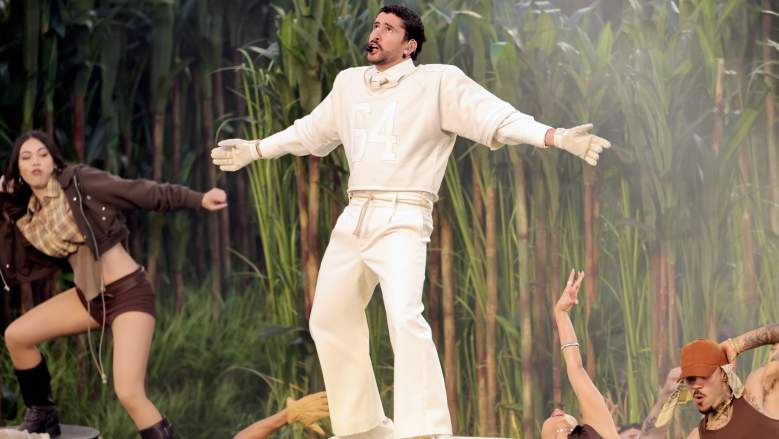
Bad Bunny delivered a visually striking performance at the Super Bowl halftime show, but one detail sparked immediate curiosity among viewers. The Puerto Rican superstar wore a cream-colored football jersey with the name “Ocasio” and the number 64 across the back. The choice was not a stylistic flourish alone. It was a personal tribute rooted in family history.
Fans quickly began speculating about the number’s meaning during and after the performance at Levi’s Stadium. According to Billboard, the number refers to the birth year of Bad Bunny’s late uncle, a figure who played a formative role in the artist’s life.
Bad Bunny, whose real name is Benito Antonio Martínez Ocasio, used the jersey to honor his uncle’s memory and influence. The gesture aligned with a halftime show that blended spectacle with personal storytelling.
Meaning Behind Bad Bunny’s ‘64’ Jersey Explained
The number 64 represents 1964, the birth year of Bad Bunny’s uncle, according to Rolling Stone. The artist has credited his uncle with introducing him to American football while he was growing up in Puerto Rico. Their shared interest in the sport became a lasting bond.
Rolling Stone reported that Bad Bunny chose to memorialize that relationship on one of the largest stages in entertainment. The name “Ocasio” on the jersey further emphasized the tribute by highlighting the performer’s family identity.
The decision is also connected symbolically to the setting. The halftime show took place at the home stadium of the San Francisco 49ers, a team Bad Bunny’s uncle supported, according to Elle. By incorporating football imagery into his wardrobe, the artist bridged personal memory with the cultural significance of the Super Bowl itself.
Vogue reported that the jersey formed part of a custom look styled by longtime collaborators, blending sportswear references with a refined monochromatic palette. The design allowed the tribute to function as both a fashion statement and an emotional symbol.
Cultural Symbolism in Bad Bunny’s Halftime Performance
The jersey complemented a performance widely noted for its emphasis on heritage, identity, and storytelling. According to Elle, Bad Bunny has consistently integrated autobiographical references into his public appearances, often using clothing as a narrative device.
In this context, the number 64 served as a subtle but meaningful detail within a larger cultural presentation. Rather than explain the reference directly during the performance, the artist allowed the symbol to speak through context and later reporting.
That restraint helped the tribute resonate beyond spectacle. The halftime show celebrated global pop influence, but the jersey grounded the moment in family memory. It illustrated how personal experiences continue to shape Bad Bunny’s artistic identity even at the height of mainstream visibility.
![Priscilla Presley Steps Out With Her Son in Rare Sighting [PHOTOS]](https://entertainmentnow.com/wp-content/uploads/2026/10/the-top-20-2026-10-21T164151.398.png?w=425)



![Tate McRae Thanks Fans for Number 1 Single With Gorgeous Bikini Pics After Spicy Victoria’s Secret Performance [PHOTOS & VIDEO]](https://entertainmentnow.com/wp-content/uploads/2026/10/GettyImages-2300897406-e1792395164465.jpg?quality=65&strip=all&w=425)

Comments
Why Bad Bunny Wore a ‘64’ Jersey at the Super Bowl Halftime Show