


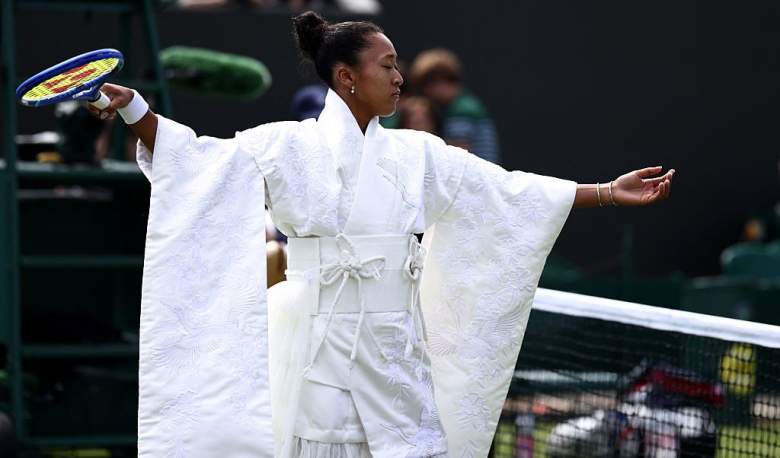
Opening day of the 2026 Championships at the All England Club belongs entirely to Naomi Osaka. Stepping onto the historic grass courts on June 29, the four-time major winner immediately delivered the first definitive viral spectacle of the summer tournament before ever striking a tennis ball. Adhering strictly to the venue’s famously rigid monochrome guidelines, the 28-year-old athlete arrived for her first-round matchup wearing a breathtaking, custom all-white kimono. The structural, floor-length garment managed to simultaneously honor strict athletic regulations and showcase deep cultural pride, turning Osaka’s entrance into an unforgettable fashion presentation.
According to ESPN, the brilliant fashion statement set the stage for an equally commanding athletic performance. Osaka quickly defeated French player Elsa Jacquemot in a swift 6-1, 7-5 victory, proving that her artistic narrative outside the lines perfectly matches her competitive focus inside them.
What Inspired the Historic Naomi Osaka All-White Kimono at Wimbledon?
The creative vision behind the striking pre-match wardrobe stems from a distinct combination of ancestral roots and cinematic pop culture. Speaking exclusively with reporters following her straight-sets victory, Naomi Osaka revealed that the architectural silhouette was heavily influenced by Quentin Tarantino’s martial arts epic Kill Bill, specifically the lethal aesthetic of a famous cinematic antagonist.
“When I think about Wimbledon, it’s obviously the all white. There’s obviously the tradition of it all,” Naomi Osaka explained during her post-match press conference. “In my head, when I think about that, I think about my cultures, my heritage, which is Japanese and Haitian. Then, if I dive deeper into Japanese culture, I think about the most iconic silhouette, which for me is a kimono. You don’t have to see the colour of a kimono to know that it is a kimono. I love Kill Bill. I remembered absolutely falling in love with Lucy Liu’s character. She has an all-white kimono, and I remember thinking that was really cool.”
By channeling the fierce, unyielding persona of O-Ren Ishii, the tennis icon used the garment to shift her mental state into a competitive headspace. The sports superstar noted that stepping onto the grand grass courts feeling like a stylized fictional character allows her to cultivate deep psychological focus, effectively detaching from external pressures to lock into her athletic assignments.
Tokyo Craftsmanship Meets the Strict All England Club Rules
Bringing this highly complex, layered concept to life required an elite level of technical precision and artistic collaboration. To execute the garment without violating any traditional guidelines, Osaka partnered closely with celebrated Tokyo-based designer Hana Yagi. The resulting outerwear masterfully adapted ancestral ceremonial draping into a streamlined, high-fashion piece that comfortably fit the athletic setting.
“I like to use fashion as a medium for storytelling,” Osaka told British Vogue during an exclusive behind-the-scenes breakdown of the design process. “Every walk-out is an opportunity to bring people into my creative world.”
The meticulous design marks a continuation of Osaka’s ongoing commitment to avant-garde athletic costuming across the Grand Slam calendar. The athlete has consistently used her global platform to challenge traditional tennis style boundaries. The minimalist, ceremonial robe follows her glittering gold French Open dress that mirrored the Eiffel Tower at night, and a dramatic, avant-garde jellyfish-inspired ensemble worn during the Australian Open in January.
Redefining Athletic Storytelling on the Historic Grass Courts
As the tournament progresses, the broader conversation surrounding the athlete is shifting from simple wardrobe metrics to her revolutionary impact on sports marketing and personal expression. By merging high-fashion curation with elite performance, the former world number one has created a unique editorial lane that commands global media attention.
The seamless intersection of Japanese heritage and modern cinematic style highlights a growing trend of athletes taking complete ownership of their visual identities.
For tournament organizers and traditionalists, the striking garment proved that athletes can completely respect centuries of sports heritage without sacrificing their personal creative voices.
RELATED CONTENT: Where Are They Now? One Half Of 90s Duo Melky Sedeck Celebrates Birthday and Personal Evolution
Comments
Court Kill Bill: Naomi Osaka Honors Japanese Tradition in All-White Kimono at Wimbledon