


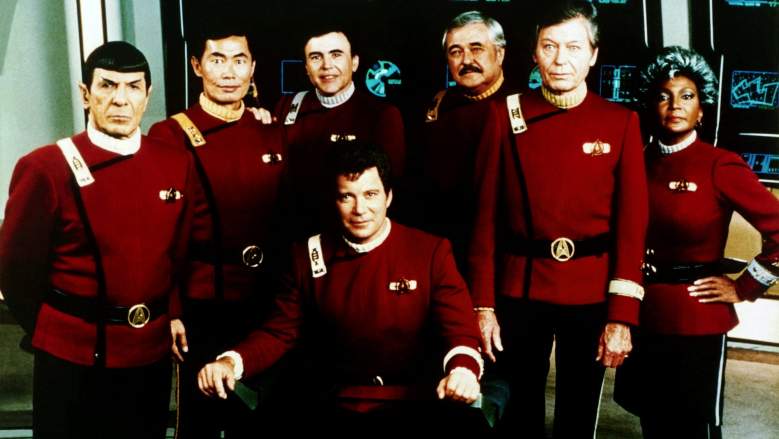
When “Star Trek” first hit television in 1966, it was not a success. The show was unceremoniously cancelled after just three seasons, and that was that. Or, it would have been, if not for syndication. The show was a hit in reruns, gathering a whole new audience of kids, teens, and sci-fi savvy adults alike.
Thanks to its resurgence in popularity (and the box office success of “Star Wars” in 1977), “Star Trek” returned, not as a TV show. but as a movie. “Star Trek: The Motion Picture,” released in 1979, marked the start of the “Star Trek” revival, a revival that continues to this day. As of this writing, every “Star Trek” movie is available to stream on Paramount+, so if you want to become a “Trek” scholar, that’s the streaming service for you.
Let’s take a look at every single “Star Trek” film and rate them from worst to best, from the films featuring the original TV crew, to The Next Generation, a time-traveling reboot, and even a direct-to-streaming spin-off, which, unfortunately, is where we’ll begin.
14 – Star Trek: Section 31
At a glance, 2025’s “Section 31” is a fitting continuation to the story of Emperor Philippa Georgiou. It’s a spin-off of “Star Trek: Discovery” that sees the cunning villain-turned-secret agent join Section 31, the infamous black ops division of Starfleet. The film boasts all the production value you’d expect from a Paramount+ “Star Trek” production, and a game cast that includes Michelle Yeoh, Omari Hardwick, Rob Kazinsky, and Sam Richardson.
Unfortunately, the film itself squanders its premise and barely resembles “Star Trek” at all. In theory, that could be exciting, as “Star Trek” is versatile and contains multitudes (That’s how it’s been able to survive for 60 years, after all), but in practice, Section 31 does nothing with the moral ambiguity of its titular organization, opting instead for a shallow sci-fi spy story.
Now, let’s not be all negative. There are some exciting action sequences here, and Michelle Yeoh brings everything she has to her role. She’s truly a sight to behold and a presence to admire. Alas, all of this whiz-bang action comes at the expense of everyone else’s characterization. Throw in a superfluous Jamie Lee Curtis cameo and “Section 31” feels like the pilot for a TV series that will never happen, rather than a grandiose conclusion to the multiversal tale of Philippa Georgiou.
13 – Star Trek V: The Final Frontier
After the massive success of “Star Trek IV: The Voyage Home” in 1986, the franchise was red hot. However, all it takes is one misstep for that heat to dissipate into nothing. Alas, that’s exactly what happened in 1989 with the release of “Star Trek V: The Final Frontier.”
Fans like to blame William Shatner for the film’s failure, but that’s not fair. In reality, he wanted to make a Roddenberry-esque philosophical adventure, elevated by Shatner’s own Shakespearean gravitas. But since “Star Trek IV” was a comedy, Paramount insisted that the sequel be funny, too. Forced humor never plays well. Then there’s the special effects. ILM, the studio in charge of previous films, was unavailable, so the film’s complex VFX sequences were given to Associates & Ferren, who were woefully unprepared for the task at hand.
The deck was stacked against “The Final Frontier” from the start, and the film bombed at the box office and with even the most die-hard Trekkies. Now, that’s not to say it’s all bad. The scene of Kirk, Spock, and McCoy around the campfire is fantastic, as are the flashbacks to Spock’s birth and the death of McCoy’s father. But overall, this movie killed all the momentum and good will the film series had built up to that point. If it wasn’t for the ongoing success of “The Next Generation” TV series and the impending 25th anniversary of the franchise, “The Final Frontier” might have ended the entire franchise.
12 – Star Trek: Generations
In May of 1994, “Star Trek: The Next Generation” ended its seven-season run. In November of that year, the first film starring the “TNG” cast was released. The filmmakers had the unenviable task of transitioning the “TNG” cast to the big screen while simultaneously crafting a send-off for Captain James T. Kirk (William Shatner) in a ‘passing of the torch’ story.
The opening of “Generations” has Kirk presumed dead during the maiden voyage of the Enterprise-B, sucked out into space, his body lost. Decades later, he’s found by Captain Picard of the Enterprise-D in The Nexus, a mysterious space cloud, where he has been timelessly living in an artificial paradise, not unlike the fate of Christopher Pike in “The Menagerie.” Unfortunately, Kirk’s appearance in the film is little more than a glorified cameo; he’s in the prologue and then he’s entirely absent until the third act, where he suffers an undignified death at the hands of Malcolm McDowell.
“Generations” has its supporters, but any fan of William Shatner, the original star of the franchise, would want more than “Generations” has to offer. Sure, the scene where the Enterprise-D crashes is really exciting and visually spectacular, and the brief scenes between Shatner and Picard actor Patrick Stewart are wonderful, but there’s nothing in “Generations” that doesn’t feel like it couldn’t have been done in an episode of the show. For the big screen debut of Picard’s crew and a final goodbye to Captain Kirk, “Generations” just isn’t enough.
11 – Star Trek: Insurrection
Coming off of the success of “Star Trek: First Contact,” hopes were high that director Jonathan Frakes could go two-for-two. He could not. While “Insurrection” isn’t the worst film in the world, it’s irrepressibly boring. It’s not cerebral like “The Motion Picture” or exciting like “Wrath of Khan.” It’s just a run-of-the-mill story about Picard and his crew protecting the Space Amish.
Okay, that’s a reductive oversimplification, but the point still stands. “Insurrection” dabbles with potentially complicated subject matter like a weakened and corrupted Federation (which wouldn’t really come into play until “Star Trek: Picard”) and the morality of displacing indigenous people in order to loot their precious resources, but it never lives up to the excitement of its “Insurrection” subtitle.
Despite boasting a budget of $70 million (far more than the $45 million spent on “First Contact”), little of that shows on screen. The movie is mostly set in what looks like the back lot of a Renaissance fair, and its special effects are largely underwhelming, especially when compared to what was going on in the Dominion War episodes of “Deep Space Nine.” Special note has to go out to Worf’s isomagnetic disintegrator, a massive bazooka that creates some sparks and makes a couple of stuntmen fall down in dramatic fashion.
10 – Star Trek: Nemesis
Maybe this is a hot take, but “Star Trek: Nemesis” isn’t that bad. I mean, it’s not very good, but there are much worse movies out there. After three movies without a coherent visual identity, “Nemesis” finally has a style that’s memorable and identifiable as its own, as well as some genuinely exciting action sequences, even if some of them feel completely out of the blue and wholly unnecessary. That being said, the climactic space battle is one of the best ever seen across all of “Star Trek.”
Unfortunately, that’s about all it’s got going for it. For a movie that aims to be the swan song of the “TNG” crew, it doesn’t seem to have much concern for its characters. The long-awaited wedding between Troi and Riker (sorry, Worf!) is glazed over, leaving characters like Wesley and Guinan as little more than extras. Then there’s the main story. The new wrinkles to Romulan history are genuinely interesting, but the space politics are undermined by the ill-advised decision to make an “evil Picard” clone. While a young Tom Hardy gives it all he’s got, and I really like his creepy costume, it’s not enough to justify its existence.
At the end of the day, “Star Trek: Nemesis” is ‘too little, too late,’ an end of an era that never really got to define itself or emerge from the shadow of its predecessor. Fortunately, the “TNG” crew would get a proper finale during the events of Season 3 of “Star Trek: Picard.”
9 – Star Trek Beyond
Now we’re entering the realm of the most polarizing entries in the series. Some love them, others loathe them. As of this writing, 2016’s “Star Trek Beyond” is the last theatrically released “Star Trek” movie. After two entries directed by J.J. Abrams, Paramount enlisted “Fast & Furious” director Justin Lin for the third film in the ‘Kelvin-verse,’ as it is known.
“Star Trek Beyond” opens with a bang and never really lets up, for better or worse. After setting the table, so to speak, “Beyond” flips the table and destroys the Enterprise, the remains of which crash-land on a mysterious planet. Here, the crew splits up for a majority of the film, which can’t help but feel like a waste of the cast. While it’s fun to see unique pairings like Kirk & Chekov and Spock & McCoy, it’s more in service of facilitating varied action sequences than interesting character dynamics.
However, it all comes together in time for the third act, which sees the crew commandeer the Franklin, an old Freedom-class ship, to prove that it’s not about the technology of the ship, but the camaraderie of its crew. As an action movie, “Star Trek Beyond” is tremendously enthralling. As a “Star Trek” story, your mileage will vary. In any case, it’s always great to see Chris Pine and the rest of the reboot cast in action. As the years go by, it seems more and more likely that this is the last time audiences will get to see them all together. At least they went out with a big, loud bang. Beastie Boys loud.
8 – Star Trek
Following the failure of “Star Trek: Nemesis” and the cancellation of “Star Trek: Enterprise” after only four seasons, it was clear that the series was going to need some new blood if it was going to survive. Enter J.J. Abrams, who shepherded the franchise through one of the most clever reboots of all time. After the events of “Nemesis,” Spock deploys Red Matter to create a black hole to contain the destruction of Romulus’ sun. Unfortunately, he and a ship led by the Romulan renegade, Nero, are sucked into the hole and sent back in time. When Nero attacks the USS Kelvin, he creates an alternate reality, which serves as the setting for this new “Star Trek” and its sequels.
We get rebooted versions of Kirk, Spock, McCoy, and the rest of the crew, but they get help from Leonard Nimoy’s Spock, who is marooned in this alternate past. The result is a delightful mix of retro and modern and a high-stakes story where nothing is sacred. Look no further than the destruction of Vulcan and the death of Spock’s mother, Amanda (Winona Ryder), for proof of that.
If there’s one problem with the “Star Trek” reboot, it’s that its script is held together by duct tape and well-wishes. Take a drink every time a miraculous coincidence occurs, and you’ll be dead of alcohol poisoning by the halfway mark, and that’s before Kirk is marooned on the same planet on which Spock Prime was abandoned, within walking distance of both Spock and a Federation outpost where Montgomery Scott is stationed. It’s absurd, but if you go along with its manic energy, you’ll still have a great time. It’s not a smart movie, but sometimes you need to play to the cheap seats.
7 – Star Trek III: The Search for Spock
Following the events of “The Wrath of Khan,” nobody knew where “Star Trek” was going to go next. There were a couple of lines that suggested Spock’s shocking death could possibly be undone, but how would they do so while still honoring his sacrifice?
Somehow, they found a way. While “The Search for Spock” is not a perfect movie, it succeeds more often than it fails, with the crew of the Enterprise deciding that, sometimes, ‘the needs of the one outweigh the needs of the many.’ Kirk goes to hell and back (almost literally, with the fiery lava of the disintegrating Genesis planet evoking the underworld) to rescue his friend. The cost is immeasurable. The Enterprise is destroyed and his son is killed, but Kirk does, as McCoy says, “What you always do: turn death into a fighting chance for life.” Best of all, “The Search for Spock” is a veritable feast for Kirk/Spock shippers. After all, Kirk leads his crew on an impossible mission to bring Spock back from death itself.
However, if there’s a secret MVP of “The Search for Spock,” it’s Christopher Lloyd as the Klingon villain, Kruge. While Klingons had previously been depicted as generic baddies, Kruge’s obsession with honor and the glory of battle influenced the way the species would be portrayed in “TNG,” “Star Trek VI,” and beyond.
6 – Star Trek Into Darkness
Let’s clear the air: “Star Trek Into Darkness” is a deeply divisive, polarizing movie. Some people absolutely hate this film. I, for one, cannot defend the recasting of Khan, an Indian Sikh originally played by the Mexican Ricardo Montalban, with Benedict Cumberbatch. It’s not so much that he’s a white actor. It’s that he’s the whitest actor. Even then, I’d be remiss if I didn’t admit that Cumberbatch absolutely rocks as Khan, even though there’s absolutely no forgiving the erasure of his original ethnicity. “Star Trek” is a celebration of the idea of IDIC, infinite diversity in infinite combinations, and stripping Khan of any trace of ethnic heritage was a bad idea, plain and simple.
Okay, with that out of the way, I really like “Star Trek Into Darkness.” Chris Pine fully steps into the role of James T. Kirk, and Zachary Quinto as Spock fully embodies this take on the character. I know many people dinged this film for its shameless homages to “Wrath of Khan,” but I didn’t mind it at all, especially since it culminates in a righteous mano-a-mano fight between Spock and Khan. Is Spock shouting “Khan” a little corny? Yeah, but “Star Trek” is often a little corny.
More interesting to me is Peter Weller as Admiral Marcus, the head of Section 31, which is depicted as shady and as dangerous to the Federation’s ideals as the organization should be portrayed. The relationship between Starfleet and the Klingons is also handled well, even if the movie has too much ADHD to allow fifteen minutes to go by without a sick stunt or action sequence, but that’s the price we pay to make “Star Trek” a mega-blockbuster series. And hey, at least the action is varied and spectacular. Overall, I fully sympathize with anyone who dislikes this movie, but… Make your own list.
5 – Star Trek: First Contact
After a shaky start with “Star Trek: Generations,” the “TNG” crew did what the original series did: make the second movie a sequel to a classic episode. While “Wrath of Khan” was based on “Space Seed,” “First Contact” is a sequel to “The Best of Both Worlds,” which saw Picard assimilated by the Borg, a race of cyborgs who bring entire planets and civilizations into their hive-mind collective. They’re a truly scary threat and “First Contact” succeeds in articulating their menace on the big screen.
In order to keep the film from being a straight-up horror movie, only half of “First Contact” focuses on the Borg menace onboard the Enterprise. The other half is a wacky time travel story about the eponymous First Contact. James Cromwell plays Zefram Cochrane (originally portrayed by Glenn Corbett in the original series episode, “Metamorphosis”), and Riker has to help him test humanity’s first Warp-capable engine, which will lead to contact with the Vulcans.
Overall, “First Contact” is a great mix of action, horror, and whimsy. Picard’s PTSD pushes him to his limits and Patrick Stewart is incredible in the role (“The line must be drawn here!”), and it’s impossible not to cheer when Worf says, “Assimilate this.” Like in “Star Trek III,” the secret VIP here is the villain, Alice Krige as the Borg Queen. She’s equally terrifying and sexy as the big boss of the Borg race.
4 – Star Trek: The Motion Picture – Director’s Edition
I’ll admit it: I’m a defender of 1979’s “Star Trek: The Motion Picture.” In particular, the Director’s Edition. Released in 2001, this was director Robert Wise’s final project before his death in 2005. Despite being a few minutes longer than the original theatrical cut, the Director’s Edition moves at a faster pace and features improved special effects and re-edited scenes.
The legend goes that the theatrical cut was being edited right up until release, and Robert Wise was never satisfied with the original version. It’s easy to see why. Even as a fan of the theatrical version, there’s no denying that it can be painfully slow at times. With the grey costumes, grey sets, and nondescript mysterious space entity that dominates the story, and it’s easy to see why people were bored and put off by “The Motion Picture.”
Nevertheless, if you can bring yourself to vibe with this film, you’re going to have a great time. Over four decades later, the visual effects are still spectacular, and they go a long way towards articulating the film’s theme that “the Human adventure is just beginning.” Its transhumanist themes, sense of mystery and the danger of space is exceptionally well handled, and it’s amazing to see the whole original cast return. I can only imagine what it was like to see the reveal of the Enterprise in theaters in 1979, a full decade after the original show had ended. The sight of the iconic Constellation-class starship, redesigned but instantly recognizable, would surely have brought tears to the eyes of any fan.
3 – Star Trek IV: The Voyage Home
Even if you’re not a “Star Trek” fan, surely you know “The One With The Whales.” As mentioned before, “Star Trek” contains multitudes. I’ve always thought of The Original Series as akin to “The Twilight Zone” in space, where anything can happen. Some stories are spooky, others are cerebral, others are funny, and still others defy genre conventions entirely. “The Voyage Home” couldn’t be more different from the prior films, and that’s its greatest strength.
Set in the immediate aftermath of “The Search For Spock,” Kirk and his friends, the crew of the Mutiny (their stolen Klingon Bird of Prey), decide to return to Earth to face the consequences of their actions in that movie. On the way, however, they have to take a detour when a mysterious probe appears in the Sol system. The probe is disabling all ships that attempt to communicate with it while broadcasting whale song. Humpback whales, to be precise. But they’re extinct. Thus, Kirk and co travel back in time to 1980s San Francisco in an attempt to find some whales and bring them back to the future.
It’s a little absurd, but wholly delightful, and full of iconic moments, from Spock nerve-pinching a punk (which got a lovely callback in Season 2 of “Star Trek: Picard”) and Chekov (Walter Koenig) asking to find the ‘nuclear wessels,’ to say nothing of Spock mind-melding with a whale. “Star Trek IV” isn’t just a great “Star Trek” movie, but an excellent time-travel story and a fantastic comedy all around.
2 – Star Trek II: The Wrath of Khan
After the mixed success of “Star Trek: The Motion Picture,” director Nicholas Meyer was brought onboard to make a sequel that was something of a reboot. While “The Motion Picture” was successful, it wasn’t beloved. And so, like how the original “Star Trek” pilot, “The Cage,” was supplanted by the more action-packed “Where No Man Has Gone Before,” so too was “The Motion Picture” ignored in favor of a new movie that aimed to win back the fanbase. Needless to say, they succeeded.
A sequel to “Space Seed” and a deconstruction of the very nature of episodic television, “The Wrath of Khan” sees the return of Ricardo Montalban as Khan. “Space Seed” ended with Khan marooned on Ceti Alpha V. The movie picks up fifteen years later. While Kirk and his crew moved on, Khan was left to survive the inhospitable environment of Ceti Alpha V, which got even worse when Ceti Alpha VI exploded, shifting the planet’s orbit to make it even more dangerous. Many of Khan’s friends, including his wife, died on the now hellish Ceti Alpha V. When a chance encounter gives Khan and his crew a chance for revenge, he will stop at nothing to destroy Captain Kirk.
Simply put, “Star Trek II” is an all-time classic. Kirk and Khan never actually appear onscreen together, only ever communicating through radio and viewscreens from the bridges of their respective ships, but it doesn’t matter. They don’t need to fistfight to do battle. They both light up the screen with their bombastic acting, with William Shatner, in particular, giving one of his all-time greatest performances as he’s confronted with middle age and the idea of growing old. Khan represents his past catching up with him, and the price he must pay for spending his whole life staring death in the face. Speaking of death, no matter how many times I watch this movie, I always cry at Spock’s funeral. “Of all the souls I have encountered in my travels, his was the most… Human.” Gets me every time, and I know I’m not the only one.
1 – Star Trek VI: The Undiscovered Country
Why not end this story with a final hot take? As universally beloved as “Wrath of Khan” may be, I still have to give the edge to the grand finale of the original run of movies, “Star Trek VI: The Undiscovered Country.” The film opens with a bang, literally. The Klingon moon, Praxis, explodes, which can lead to the complete destruction of the Klingon race. Klingons have always been enemies of the Federation, so many in Starfleet, including Captain Kirk, would like nothing more than to see them die out forever. But that’s not the Starfleet way, so Kirk, on his final mission as Captain of the Enterprise, is sent to negotiate peace between the Federation and the Klingon Empire. Inevitably, things go wrong when a conspiracy of Federation and Klingon spies conspires to murder the peace-seeking Klingon Chancellor Gorkon. If the Federation and Klingons can work together to prolong bloodshed, then maybe they can work together to seek peace.
The legend goes that, after the failure of “Star Trek V: The Final Frontier,” Paramount wanted to make a prequel movie about Kirk, Spock, and McCoy in Starfleet Academy, played by younger actors. However, for the sake of the 25th anniversary of “Star Trek” in 1991, the decision was made to create a grand finale movie for the original crew. Given the result, I’d say they made the right choice.
Just as “Wrath of Khan” was defined by the verbal combat between Kirk and Khan, so too is “The Undiscovered Country” buoyed by the scenes between Kirk and General Chang, played by Christopher Plummer. He’s amazing in the role of a duplicitous Klingon schemer who quotes Shakespeare in Klingon. Once again, he and Kirk never have a fistfight, but that doesn’t make their relationship any less adversarial. Leonard Nimoy also shines in this one, with Spock having finally reconciled his mixed-race heritage, embracing both his logical Vulcan side and his intuition as a human, to tremendous effect. Throw in one of the greatest endings ever, and “The Undiscovered Country” truly feels like it’s closing the book on an entire generation of “Star Trek” adventures.











Comments
Every Star Trek Movie Ranked From Worst To Best