


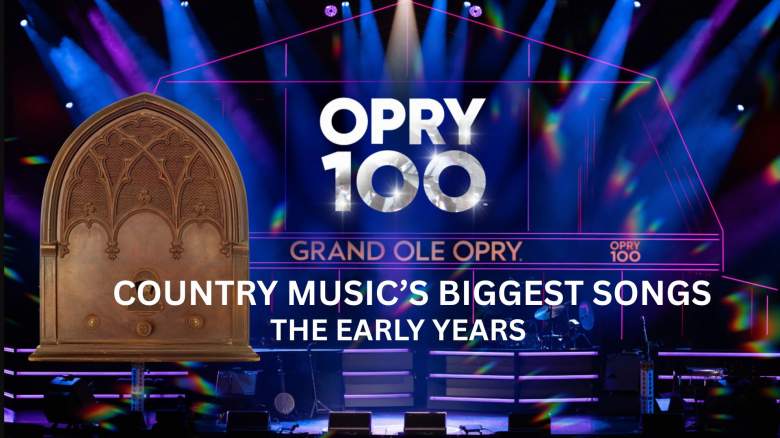
The Grand Ole Opry is celebrating its 100th birthday all year. And it’s getting fans’ help as it looks back on its rich history.
The Opry is naming the 100 Greatest Country Songs of all time, with the help of fans who have weighed in, nominating their favorites. All summer long, the Opry will be releasing lists separated by era. By the end of the summer, fans will have the ultimate country playlist.
In its first list, the Opry is giving fans a glimpse of the 18 greatest country songs released from the 1930’s through the 1960’s.
Here are the songs that made the cut, along with fan descriptions on why they got the votes.
‘Silver Wings’- Merle Haggard
The Opry’s first choice is explained like this by voter Nicole Judd: “’Silver Wings’ isn’t just a song—it’s a feeling. Written and recorded by Merle Haggard, this 1969 ballad is all about watching love fly away, literally and figuratively. Though never released as a single, it became one of Haggard’s most beloved songs, a staple in his concerts and a favorite among fans. With its dreamy melody and aching lyrics, ‘Silver Wings’ captures the loneliness of watching someone leave, knowing there’s nothing you can do to stop them. …More than 50 years after its original release on an album titled A Portrait of Merle Haggard, “Silver Wings” is still one of the most beautiful heartbreak songs in country music.”
You may also remember Garrett Hedlund singing his version of the song in the 2011 movie “Country Strong” starring Gwyneth Paltrow.
‘Harper Valley PTA’- Jeannie C. Riley
The Opry’s second choice spawned a 1981 NBC TV show by the same name.
The Opry inclusion of this song is explained like this by WSM Radio DJ Charlie Mattos: “This country and pop hit from 1968 provided quite an introduction into the music world for both its artist and songwriter. For Jeannie C. Riley, the irresistible song gave her a signature hit with sassy lyrics and provocative album artwork that perfectly fit her personality. While she would hit the Billboard Top 40 a dozen more times, this was her only trip to #1.”
‘Folsom Prison Blues’- Johnny Cash
No list of the greatest country songs of all-time would be complete without featuring something from the Man in Black.
Craig Shelburne, who wrote The Opry’s “100 Years of Grand Ole Opry” book, explains the inclusion of Johnny Cash’s famous hit, which he once performed live at San Quentin Prison: ““Hello, I’m Johnny Cash.” That simple, resonant phrase entered the country music lexicon in 1968, as the Man in Black introduced himself to the inmates of Folsom State Prison, then launched into one of his early hits, “Folsom Prison Blues.” …Infused with the intensity of his captive audience, the new version of “Folsom Prison Blues” delivered Cash’s first No. 1 hit in five years.. Cash had parted ways with the Opry by this time, yet “Folsom Prison Blues” has never been a stranger to the Opry stage. Chris Janson, Chris Stapleton, Josh Turner and more have revived this Cash classic in the Opry circle.”
‘Rocky Top’- The Osborne Brothers
Before it became the fight song for the University of Tennessee, “Rocky Top” was a hit for the Osborne Brothers.
The Opry’s Craig Shelburne has this to say about the hit: “The Osborne Brothers introduced country fans to good ol’ “Rocky Top” on Christmas Day, 1967, long before it emerged as a bluegrass festival favorite, an official state song of Tennessee, and a rallying cry at University of Tennessee football games. Felice and Boudleaux Bryant wrote “Rocky Top” in about 15 minutes in a Gatlinburg, Tennessee, hotel room. Sonny and Bobby Osborne, Opry members since 1964, recorded the nostalgic tune on a whim, needing one more number to round out a recording session. Chet Atkins, Charlie Daniels Band, Dolly Parton, and many other country legends have tackled the irresistible “Rocky Top,” too. Commemorating the 50th anniversary of the song in 2017, Bobby Osborne told the Tennessean, “If I’m at the Opry and I have two songs (to play), one of them will be ‘Rocky Top.’ And if I just do one song in the segment, that one will be ‘Rocky Top.’”
Now, the song is synonymous with the Tennessee Volunteers, played after every touchdown, basket, victory or even for no reason at all. Tennessee fans have claimed the song as their own and there’s no going back.
‘Stand By Your Man’- Tammy Wynette
While the Opry posted this selection without comment, according to The Boot, “Stand By Your Man” reigned in the top spot on the Billboard Hot Country Singles chart in November, 1968.
It was also a crossover hit, reaching number 19 on the all-genre Billboard Hot 100.
But as The Boot article pointed out, while “Stand By Your Man” seems to champion tolerating infidelity and bad behavior, many of Wynette’s hits sang a different tune, including “Your Good Girl’s Gonna Go Bad” and “Stayin’ Home Woman (Gettin’ Tired of Her Stayin’ Out Man),” no to mention her hit, “D-I-V-O-R-C-E.”
‘Mama Tried’- Merle Haggard
Country singer Sunny Sweeney makes the case for the Merle Haggard classic. She writes: “According to his song, “Mama Tried,” (one of his 38 #1 songs) his daddy left his momma a heavy load trying to fill up daddy’s shoes after he died. I personally think this is my favorite Merle song, enough so that I tattooed it on my body. I even got a chance one time to show him my arm where it’s emblazoned. He said, “Wow, now that is a big fan.” My favorite story about my tattoo is that my own father finally saw it after I had managed to hide it for a couple years. He came over and picked up my wrist and said, “What does that say? Mama Tried? Well she didn’t try hard enough or my daughter wouldn’t be walking around with tattoos.”
Miranda Lambert famously immortalized those words in her debut hit. Twenty years ago, Miranda wore a white tank top emblazoned with “Mama Tried” in the video for “Kerosene.” And Ella Langley paid homage to that moment at this year’s ACMs, when she took the stage with Lambert to sing the song.
‘You Ain’t Woman Enough’- Loretta Lynn
Sunny Sweeney also penned the Opry’s explainer on the inclusion of Loretta Lynn’s classic “You Ain’t Woman Enough to Take My Man.”
Sweeney writes, “Loretta Lynn is my hero. She was the kindest woman I have ever met, never minced a single word and stood up for what she believed in …all reflected in the words of her songs… I remember a time I opened a show for her in Texas in July, outdoors in Austin. I was dying in my jeans and shirt, and she just walked out in what looked like a 60-pound sequined dress acting like she was in the Antarctic. She pranced around the stage telling the stories behind the songs and when it got to the 1966 banger ‘You Ain’t Woman Enough,’ she said, “And if I saw that woman today, I’da guarantee I’d still take her out now.”
According to American Songwriter, “You Ain’t Woman Enough” was Lynn’s biggest hit. It reached No. 2 on the country charts. And her album of the same name went all the way to number one.
Legend has it the song was inspired by a fan. The woman confided to Lynn that a rival was trying to take her husband. Lynn responded, “honey, she ain’t woman enough to take your man!” and reportedly then wrote the song in ten minutes.
‘Once A Day’- Connie Smith
Craig Shelbourne explains the Opry’s choice of “Once a Day” like this, “Connie Smith is considered the Sweetheart of the Grand Ole Opry, earning that distinction from the King of Country Music himself, Roy Acuff. Few singers have enchanted country fans as quickly as Smith did in 1964 with “Once a Day.” Hearing her perform a Jean Shepard song in a talent contest, Opry member Bill Anderson instantly recognized the rare vocal gifts of this unknown singer. They soon forged a friendship and professional relationship as Anderson helped her secure a recording contract and even composed her breakout hit. Smith’s emotional rendition of “Once a Day” spent eight weeks at No. 1, setting a record for women in country music. A lifelong fan of the Opry, Smith joined the cast on August 21, 1965. Dolly Parton, an Opry member since 1969, commented, “I used to stand backstage, and watch her and think, ‘Wow, that girl can sing!’”
‘Ring of Fire’- Johnny Cash
Johnny Cash’s second appearance on the Opry’s list won’t be his last.
Opry Vice President & Executive Producer Dan Rogers writes, “Written by Merle Kilgore and June Carter about flames of love that simply cannot be put out, “Ring of Fire” was first a release for Carter’s sister, Anita Carter. Johnny Cash heard Anita’s version, recorded his own rendition in 1963, and later said the thoughts of adding mariachi horns/trumpets to the tune came to him in a dream. Featuring background vocals by Mother Maybelle & The Carter Sisters and future Opry star Jan Howard, Cash’s recording of “Ring of Fire” spent seven weeks at number one on the Billboard country chart. It’s since become one of the most listened-to country songs in history, utilized in everything from a Levi’s commercial to a victory song following each NHL Calgary Flames victory. Five years after its release, Johnny & June married in Franklin, Kentucky, forming one of country music’s most famous unions. “Ring of Fire” entered the Grammy Hall of Fame in 1998.”
‘Sweet Dreams (Of You),’ ‘I Fall to Pieces’ and “Crazy’- Patsy Cline
The next three songs on the list all belong to the legendary Patsy Cline.
While the Opry listed “Sweet Dreams (of You)” without comment, the legendary singer recorded it just one month before her death. Reba McEntire performed that song acapella to kick off the “Opry 100: A Live Celebration” with a tribute to Pasty Cline and Loretta Lynn.
As for “I Fall to Pieces,” Craig Shelborne reports that Patsy Cline needed a hit when she agreed to record the song before she even heard it. It was a good call- going to number one in 1961.
When it comes to “Crazy,” Country Music Hall of Fame pianist Randy Hart writes, “When Patsy first heard the original version that Willie Nelson sang, she didn’t think it was for her. Fortunately, her producer told her it was perfect for the album she was working on and to leave it to him to make it work. Recorded at the historic Quonset Hut on 16th Avenue here in Nashville, the music was recorded with the rhythm section and background singers (The Jordannaires) before Patsy came in a week later and sang it in one take. Pure magic.”
‘El Paso’- Marty Robbins
Opry historian Craig Shelburne writes, “Marty Robbins’ 1959 classic, “El Paso,” carried the Old West to the country airwaves. Robbins had already secured #1 hits with lush romantic ballads and straightforward heartbreak songs, so writing a cinematic story of a Mexican beauty involved in a murderous love triangle seemed somewhat out of character. However, Robbins didn’t underestimate the audience’s ability to follow the story and he knew a whole generation of his fans grew up watching Westerns. However, radio programmers questioned the single’s running time of four minutes, thirty-eight seconds—far more than the standard three-minute length of most hits back then. Robbins, an Opry member since 1953, simply asked them to give it a chance. (Reportedly, some disc jockeys also used it as an opportunity for a bathroom break.) The risk paid off, as “El Paso” reached #1 on the pop and country charts, and earned a Grammy for Best Country & Western Performance.”
Opry stars Jon Pardi and Drake Milligan sat down to talk about why “El Paso” is so unique. Drake Milligan said, “One of the best country songs ever written. And also a five minute song without a chorus.” John Pardi agreed, saying, “When they say country music tells stories, ‘El Paso’ tells a hard story.”
‘Walking After Midnight’- Patsy Cline
Patsy Cline appears on the list a fourth time for “Walking After Midnight.” It’s a song she sang when she was not yet a legend, but rather a rising star.
Nicole Judd says Cline sang the tune on the network television show “Arthur Godfrey’s Talent Scouts.” And “the response was immediate—’Walkin’ After Midnight’ shot up the charts and introduced the world to her unmistakable voice.”
‘I Walk the Line’- Johnny Cash
“I Walk the Line” is Johnny Cash’s third appearance on the list.
Opry historian Craig Shelborne writes, “Cash composed “I Walk the Line” as he grappled with the temptations of the road, particularly as a 24-year-old married man touring with Elvis Presley. You can hear Cash humming for just a moment before singing a verse, which may be an attempt to stay in tune amid all the modulation. But the vocal maneuver also gave the song a cool hook, one that still works almost 60 years later. Cash and the Tennessee Two performed “I Walk the Line” at their Opry debut at the Ryman Auditorium in 1956. Later that month, it became Cash’s first number one country single and spent six weeks at the top. Two years after Cash’s death, the song inspired the title of the Oscar-winning 2005 biopic, “Walk the Line.”
‘Your Cheatin’ Heart’ & ‘I’m So Lonesome I Could Cry’- Hank Williams
The next two songs on the Opry 100 list are by Hank Williams.
According to the Grand Ole Opry, Williams “never had the chance to hear “Your Cheatin’ Heart” on the radio, or to see it become perhaps the best-known heartbreak song in country music history. On a summer drive to Louisiana with his fiancée, Billie Jean Jones, Hank recounted the most difficult experiences with his ex-wife, Audrey, and off-handedly remarked, “Her cheatin’ heart will pay!” Suddenly realizing that a song was bubbling up, Hank asked Billie Jean to rustle up a pen and paper, then rattled off the words in about ten minutes as she jotted them down. Hank recorded the song in his final studio session in the fall of 1952, about a month after his dismissal from the Opry cast for drunken behavior and missing his scheduled appearances. The palpable pain in Williams’ voice in “Your Cheatin’ Heart” would reflect the grief of his fans when they learned of the legendary artist’s untimely death on New Year’s Day 1953. “
Williams recorded “I’m So Lonesome I Could Cry” three years earlier in 1949. Nicole Judd writes, “Considered one of the saddest songs ever written, the song’s haunting lyrics and Williams’ sorrowful delivery make it clear—this is country music at its most raw and real.”
‘Wabash Cannonball’- Roy Acuff
Opry Vice President & Executive Producer Dan Rogers writes, “If the Opry had a theme song, next to “Will The Circle Be Unbroken,” it’d be “Wabash Cannonball,” popularized on the Opry airwaves by the King of Country Music and Opry patriarch Roy Acuff. The tale of the fictional train and its vistas was the first song performed when the Opry House opened in 1974, and countless times until Acuff’s passing in 1992. The song lives on at the Opry, including in celebration of the 40th and 50th anniversaries of the Grand Ole Opry House. Opry members Johnny Cash, Flatt & Scruggs, George Jones, Boxcar Willie also recorded the folk classic, and it remains a favorite of marching bands and pep bands. A roller coaster inspired by the song and once a hallmark of the now-defunct Opryland theme park, however, lost its thrill. It was relocated to Old Indiana Fun-n-Water Park in Thorntown, Indiana, and was subsequently moved into storage more than two decades ago.”
‘Will the Circle Be Unbroken’ – The Carter Family
Last but not least, the ultimate Opry song- “Will the Circle Be Unbroken” by the Carter Family is as “Opry” as it gets.
Dan Rogers writes, ““Will the Circle Be Unbroken” has become nearly synonymous with the Opry and with the Opry family coming together for both joyous milestone celebrations and trying times in the life of the Opry or one of its members. It was written as a Christian hymn in 1907 by Ada R. Habershon with music by Charles H. Gabriel. In the 1930s, A.P. Carter reworked the song including its lyrics and released it with The Carter Family in that same decade. In addition to the famed 1972 performance by Maybelle Carter and a cast assembled with the Nitty Gritty Dirt Band on an album of the same title, “Will the Circle Be Unbroken” has been recorded by Opry stars including Bill Monroe and George Jones as well as John Lee Hooker, Susan Boyle and many others over the course of decades.”
Indeed, the Opry stage contains a “circle” singers stand in to perform. And it’s made up off boards from the original Opry stage at The Ryman Auditorium.
And at the Grand Ole Opry’s “Opry 100: A Live Celebration” March 19, a star-studded cast took the stage to perform the quintessentially “Opry” song. It doesn’t get more Opry than that.


Comments
Grand Ole Opry Names 100 Top Songs of Country Music