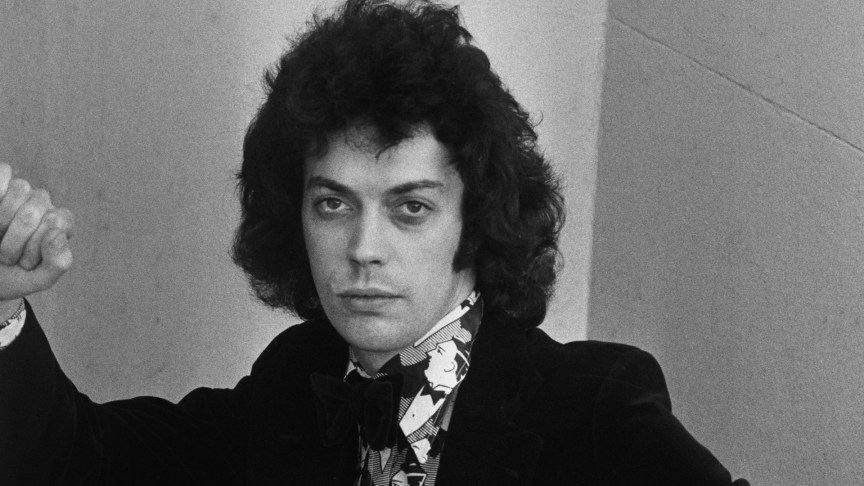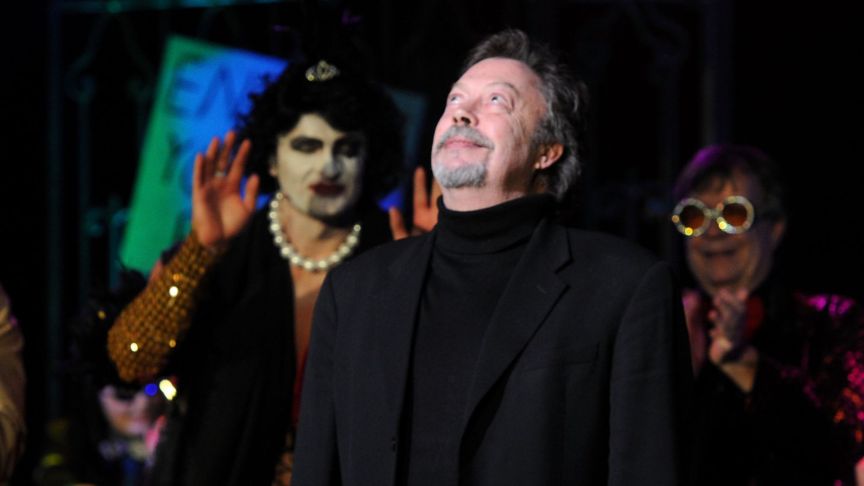
Tim Curry spent decades playing memorable characters on stage and screen, but away from Hollywood, the actor created a Los Angeles home that reflected his love of history, art and gardening.
Curry died at age 80 at his Los Angeles home, TMZ confirmed on August 26. The British actor was best known for playing Dr. Frank-N-Furter in “The Rocky Horror Show” and its 1975 movie adaptation, “The Rocky Horror Picture Show.” His credits also included “Annie” and the 1990 “It” miniseries.
In a 1998 Architectural Digest feature, Curry opened the doors to his historic 1922 Spanish Colonial Revival home and revealed the unusual story of how he came to own it.
The house had once been scheduled for demolition, and another potential buyer had recently backed out. None of that stopped Curry from deciding almost immediately when he saw the property.
Tim Curry Bought His Los Angeles Home After One Look at the Backyard
Curry first visited the property with his friend and fellow actor Annie Potts, who considered it her favorite Los Angeles home.
The home had been painted what the outlet described as a Campbell’s Tomato Soup orange. But Curry’s attention quickly turned to what was outside.
When the French doors in the living room opened to reveal a terraced, grotto-filled canyon behind the patio, Curry had an immediate reaction.
“Oh my God,” he said. “We’re in Ecuador.”
Curry made an offer “that minute,” according to Architectural Digest, although his excitement was quickly replaced with nerves.
He said he immediately went into “the world’s longest anxiety attack.”
Then he discovered another unusual detail about the property.
“I soon learned that the previous bidder had been told by her psychic that the house was haunted and had just withdrawn from escrow,” Curry recalled.
The house did not turn out to have a supernatural problem. Instead, Curry found himself surrounded by history.
Architect Stiles Clements designed the home in 1922. Its Spanish Colonial Revival features included thick stucco walls, arched doorways, deep recesses and a red-tile roof.
Curry particularly appreciated what the house did not have.
“It has none of those elements one sees so often: festivals of wrought iron, little Juliet balconies, guitars strumming in every corner,” he told the outlet.
The ‘Clue’ Star Made His Historic Home a Reflection of His Life
Curry did not attempt to recreate exactly how the house might have looked when it was built.
Instead, he filled it with pieces he had collected over several decades, including Stickley furniture he found on the street during the 1970s and 18th-century English antiques.
“That’s what I like, really — making contradiction work,” Curry said.
The home also featured an extensive collection of drawings, oil paintings and portraits.
Curry said he took inspiration from photographs of writer Gertrude Stein’s famously art-filled Paris apartment.
“I’ve always loved photographs of Gertrude Stein’s apartment on the rue de Fleurus,” Curry said. “It was crammed with extraordinary pictures that nobody else wanted to buy.”
Designer Jim Lassiter helped Curry with textiles and colors throughout the property, even creating an oversized ottoman based on an idea Curry had held onto for years. Curry wanted it large enough to accommodate a person, a tray and a dog.
He also put considerable thought into color. The dining room featured dark persimmon, while guest bedrooms were painted soft green.
“I do think that red encourages the appetite,” Curry said.
Of green, he explained, “A great color to think in, which is why it’s in the guest bedrooms.”
Tim Curry’s Love of Gardening Extended to Freddie Mercury’s Home
The property also gave Curry an outlet for one of his biggest interests away from acting: gardening.
Architectural Digest described Curry as an avid horticulturist who worked not only on his own gardens but also on those of friends. Among them was Queen frontman Freddie Mercury.
Curry jokingly attributed his love of gardening to his English roots.
“I think if you’re English, a trowel appears in your hand when you’re 30 like a prosthetic device,” he said.
For Curry, creating his home ultimately became less about Hollywood and more about building a place where he and his friends wanted to spend their time.
“It’s rather like designing a set for the life you wish to pursue,” Curry told Architectural Digest. “When I truly had a place that I wished to call home, I wanted it to be equally marvelous for my great friends, the other ‘cast members.’”
After years spent moving between major cities for his career, Curry said his priorities had changed.
“Once I stopped rushing about the world, trying to colonize London and New York and Los Angeles,” he said, “I realized there were more important things in life than a marquee.”