The words “legend” and “icon” tend to be thrown around a lot when it comes to the music industry.
Yet in the case of a singer and songwriter who’s been performing for more than 60 years, spanning numerous musical genres while racking up hits spanning from the early 1960s until the late 1970s, it’s more than applicable.
Frankie Valli Announces His Retirement
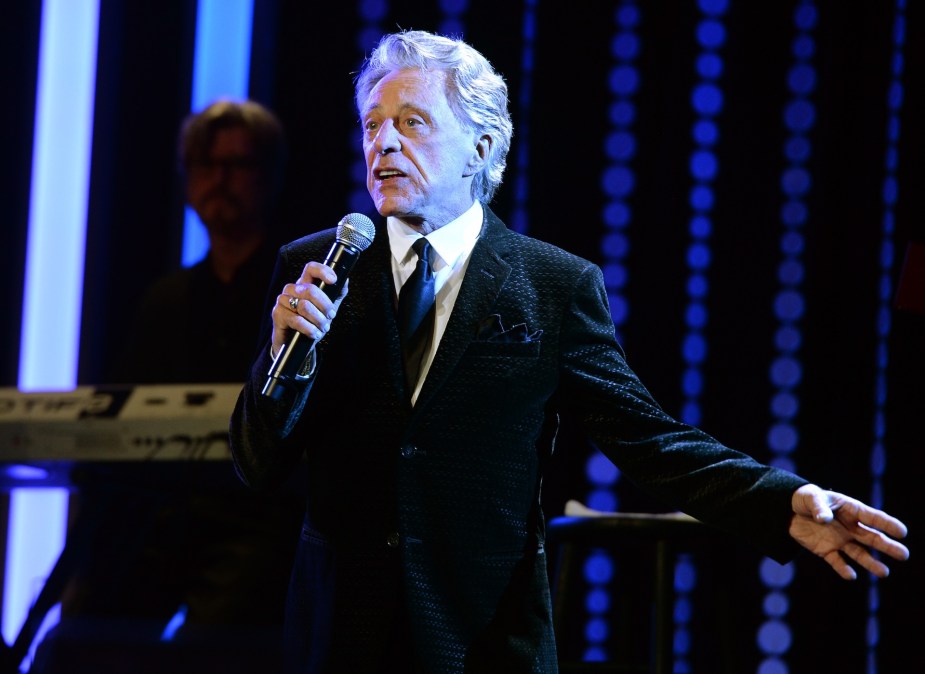 Getty
GettyThat performer is Frankie Valli, who burst on the scene in the early 1960s as the lead singer and chief songwriter for The Four Seasons.
On August 12, the singer’s brother, Bobby Valli, took to Facebook to announce the “living legend” had officially retired from live performing.
“My brother Frankie, whom I am so proud of and love him dearly,” Bobby wrote in the all-caps post. “He has had a wonderful life, a dream come true. He is an incredible singer. Has had a magnificent career in music.”
Hanging Up His Mic at 92
“He has millions of fans who love him dearly. He is now 92 years old. In his illustrious career, he has sold over 100 million records, R&R Hall of Fame,” the post continued.
“He will now retire. We will always have special memories of Frankie Valli. He has reached a place in his life where his family is there to love, cherish and to be there for him,” he wrote before concluding, “We appreciate your love and concern.”
A Canceled Tour
The news arrives a few months after the 92-year-old Valli pulled the plug while in the midst of his 2026 tour, cancelling all remaining dates in late May.
While no specific ailments were mentioned, at the time he said the decision was made in order to “focus on my health.”
A rep for the singer told Variety that Valli “realized he needed to take a break and get his health in order, and that is the true issue.” At that point, the rep said that Valli was eyeing a return to the stage in 2027.
The Four Seasons
In the early 1960s, Valli and a group of pals from their native New Jersey formed a singing group. Calling themselves The Four Seasons, the group broke through in 1962 with the No. 1 hit “Sherry.”
Led by Valli’s soaring falsetto, The Four Seasons racked up a string of subsequent No. 1 singles including “Big Girls Don’t Cry,” “Walk Like a Man” and “Rag Doll.”
While remaining a member of the group, Valli began pursuing a side career as a solo artist in the mid-1960s. In 1967, he released his classic hit single “Can’t Take My Eyes Off of You,” which peaked at No. 2.
As a solo act, Valli charted nine top-10 hits, including 1974’s “My Eyes Adored You” and, the following year, “Our Day Will Come.”
Meanwhile, The Four Seasons scored their final No. 1 in 1976, with the hit “December, 1963 (Oh, What a Night).”
‘Grease’ Is the Word
Valli’s career received a big resurgence thanks to the massive success of “Grease,” the 1978 movie musical that broke box office records and sent its soundtrack to the top of the pop charts.
Among the movie’s many hits was the disco-adjacent title track, performed by Valli.
He also appeared in the movie, as an angelic figure who sings “Beauty School Dropout” to Pink Lady (played by Didi Conn).
Further Success with ‘Jersey Boys’ and ‘The Sopranos’
Valli also dabbled in acting. From 2004-2006, he played a recurring role on “The Sopranos” as Rusty Millio, a high-ranking capo in New York’s Lupertazzi crime family.
Nearly 30 years after their last No. hit, Valli and The Four Seasons returned to the limelight with “Jersey Boys.” Making its Broadway debut in 2005, the musical — which chronicled the group’s complicated history through The Four Season’s most iconic songs — became an enduring crowd-pleaser that ran for a staggering 11 years.
“Jersey Boys” was adapted for the screen in 2014, with the film written and directed by Clint Eastwood.
“I’ve always felt there was a real story behind this, about four guys who grew up with conditions in life that were not the very best and didn’t know whether they were going to make it or not in anything,” Valli told the Smith Center of bringing his life story to the stage.
“I look at my life, and I think how lucky I really was that I didn’t end up in a trunk of a car or in jail,” he said of his early years, “it was just a hard time where all you had were dreams.”